
The Honest Recommendation
We constantly see families default to the wrong life insurance product simply because of aggressive television marketing. The clear answer for most homeowners and business owners aged 50 to 75 comparing guaranteed issue vs simplified issue is to try simplified first. It costs significantly less, avoids waiting periods, and processes just as quickly.
If health concerns lead to a decline, guaranteed issue remains a permanent fallback option. You risk nothing by applying for the cheaper policy first. Guaranteed acceptance products dominate mailers and lead-mill phone banks because they require zero health questions.
This makes them incredibly easy for captive agents to sell for higher commissions. Our team routinely reviews data, and the premium gap between these two options is substantial.
The True Cost of Skipping Health Questions
InsuranceGeek’s 2026 pricing data shows that a 70-year-old male seeking a $10,000 final expense policy pays about $69 a month for simplified coverage. That same person pays roughly $99 for guaranteed acceptance. This marks a massive 42% markup for bypassing the questionnaire.
You also avoid the dreaded two-to-three-year graded death benefit window by choosing the simplified route. Guaranteed policies from carriers like Gerber Life typically return your premiums plus 10% interest if you pass away from natural causes during those first 24 months. When that surcharge is genuinely justified is a separate question we tackle in Is Guaranteed Issue Worth the Higher Cost?.
Simplified applications bypass this restriction entirely. Your family receives immediate financial protection from day one.
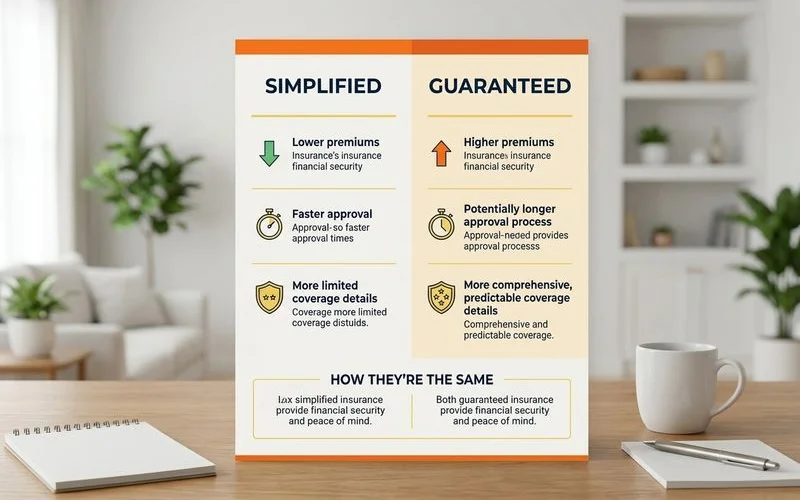
Side by Side: Guaranteed Issue vs Simplified Issue
Comparing these two policies directly reveals why answering a few health questions is so valuable. The table below highlights the massive differences in cost, coverage limits, and approval speed for US applicants in 2026.
| Feature | Simplified Issue | Guaranteed Issue |
|---|---|---|
| Medical exam | None | None |
| Health questions | 10 to 15 yes or no | None |
| Coverage from day one | Yes, full benefit | No, graded period 2 to 3 years |
| Death benefit during wait (natural causes) | N/A | Premiums plus 10% interest |
| Premium (typical $10k, age 65, healthy male) | $55 to $95 | $90 to $140 |
| Max face amount | $25k to $50k+ | $25k to $40k |
| Approval timeline | 24 to 72 hours | Same day |
| Approval rate | 70% to 85% of applicants | 100% (ages 50 to 85) |
We updated these figures to reflect current market averages, but individual carrier rates will vary. The most striking contrast is the maximum coverage amount available. Simplified options from companies like SBLI or Pacific Life can stretch up to $100,000 or more.
Guaranteed products strictly cap out around $25,000 to $40,000.
Another critical difference involves the behind-the-scenes approval mechanism. Underwriters for simplified products verify your questionnaire answers using databases like the Medical Information Bureau and prescription drug trackers like Milliman IntelliScript. Guaranteed policies skip these database checks completely, which explains their higher price tag.
Who Each Fits
Selecting the right product depends entirely on your specific medical history and prescription records. Simplified policies work beautifully for individuals with controlled health conditions. Guaranteed options serve as a vital safety net for those facing severe or terminal illnesses.
The Ideal Candidates for Simplified Underwriting
We always recommend this path for applicants who can pass a basic 10 to 15-question health survey. Underwriters are surprisingly forgiving of many common ailments if they are well-managed with medication.
Simplified issue is right for:
- Most people aged 50 to 75 with controlled common conditions
- Individuals with Type 2 diabetes, and sometimes Type 1 depending on the carrier
- Business owners and homeowners with controlled hypertension
- Cancer survivors past the typical two-to-five-year lookback window
- Heart-event history once stable for over a year
- Anyone who can pass the questionnaire for cheaper, day-one coverage
One major pitfall to avoid is assuming you need guaranteed acceptance just because you take daily medications. Prescription databases will flag severe drugs used for COPD or HIV, but standard maintenance pills rarely cause a decline.
When to Choose Guaranteed Acceptance
Our industry experience shows that these no-questions-asked policies are a financial lifesaver for specific, high-risk scenarios. You should only pursue this route if you have a condition that triggers an automatic decline in the simplified tier.
Guaranteed issue is right for:
- Active cancer treatment or recent diagnosis
- Advanced COPD requiring continuous oxygen
- Dementia or Alzheimer’s diagnosis
- Recent severe heart event or stroke within the last 12 months
- Kidney failure requiring active dialysis
- Anyone declined for simplified issue at multiple carriers
Applying for a guaranteed policy when you are healthy is a costly mistake. You will pay a premium surcharge and unnecessarily subject your family to a multi-year waiting period before the full death benefit activates.
The Right Order of Operations
The most cost-effective strategy is to apply for a simplified policy first and only use guaranteed acceptance as your backup plan. Following a strict sequence ensures you secure the highest death benefit for the lowest possible monthly premium.
We developed a proven three-step framework that protects our clients from overpaying. Captive agents who skip the first step are usually optimizing for their own commissions rather than your financial well-being.
- Shop simplified issue across multiple A-rated carriers through an independent broker. Don’t apply at just one company. The same person can be approved at carrier B after being declined at carrier A because underwriting guidelines vary wildly.
- If approved: place the simplified-issue policy. Done. You get full coverage from day one, a locked-in premium for life, and no waiting period.
- If declined everywhere: then accept guaranteed issue. The product exists specifically for this situation and is genuinely valuable when it is the only remaining answer.
This is the entire honest framework for choosing between guaranteed issue vs simplified issue life insurance. A true independent broker will run your medication list through a quoting engine to predict which simplified carrier will view your profile favorably.
Reach out to a licensed professional today to start comparing quotes in your state.
Don’t default into the more expensive product. Try the cheaper option first. You can always fall back if needed.