The Goal: Land in Simplified Issue, Not Guaranteed
We see the same frustration constantly when helping homeowners and business owners protect their assets.
Many capable applicants default into expensive guaranteed policies when they could easily secure simplified issue coverage. This product is the cheaper, faster, and better financial move.
It gives you full protection from day one with no waiting periods and a much lower premium, which is the heart of the day-one coverage advantage over guaranteed issue.
Our team recently reviewed 2026 pricing data from InsuranceGeek. A 70-year-old male in the US buying $10,000 in coverage pays around $69 a month for simplified issue, compared to $99 for guaranteed issue.
That 42 percent price hike is a massive penalty for skipping the underwriting questionnaire.
The work of learning how to qualify for simplified issue life insurance is not about gaming the system. You just need to apply with the right carrier for your specific health profile.
Most people who end up in the wrong product only talked to one captive carrier or an agent who failed to shop their case properly. Here are the specific health markers carriers evaluate and exactly how to sequence your applications.
Conditions That Often Still Pass Simplified Underwriting
Common Health Profiles and Carrier Preferences
Many business owners assume a chronic illness automatically forces them into a guaranteed policy. Our experience shows that these conditions are routinely approved at simplified-issue rates when you choose the correct carrier.
A “yes” answer on an application questionnaire is not an automatic disqualification. You can often pass life insurance underwriting with standard rates if your symptoms are stable.
We recommend waiting at least six to twelve months after a new diagnosis before applying, as underwriters want to see a documented pattern of medical control.
| Health Condition | 2026 Underwriting Threshold for Simplified Issue | Typical Carrier Decision |
|---|---|---|
| Type 2 Diabetes | A1C below 7.0% (Standard Plus possible) or under 8.5% | Standard rates at lenient carriers |
| High Blood Pressure | Controlled with oral meds, no recent hospital visits | Preferred or Standard rates |
| History of Cancer | 5+ years past final active treatment | Standard or graded coverage |
- Insulin-dependent diabetes: Approval varies widely by carrier, but companies like Corebridge Financial offer favorable terms for stable daily units.
- High cholesterol: Treated with or without statins usually qualifies for preferred rates.
- History of heart attack or stent: Stable condition for over five years typically secures standard or graded options.
- COPD (mild, no oxygen): Graded or standard at specific carriers like American Amicable.
- Sleep apnea: Using a CPAP machine regularly usually yields preferred or standard rates.
- Anxiety or depression: Controlled with medication and no recent hospitalizations typically passes easily.
Conditions That Usually Require Guaranteed Issue
You must be realistic about which health histories flag an immediate decline.
The conditions that almost universally rule out simplified issue include:
- Active cancer treatments like chemotherapy.
- A clinical dementia or Alzheimer’s diagnosis.
- A severe stroke or heart attack within the last 12 months.
- Advanced COPD requiring continuous oxygen therapy.
- Currently residing in a nursing home with ADL (Activities of Daily Living) dependency.
- Terminal diagnosis with a life expectancy under 12 months.
If your profile includes one of these markers, guaranteed issue is the appropriate safety net.
Carrier-Shopping for Lenient Underwriting
Different A-rated carriers have very different underwriting tables. Among the major final expense carriers in the US market, each has its own distinct niches and maximum face amount limits.
Our agency tracks these carrier preferences closely to match homeowners with the right fit.
For example, Mutual of Omaha’s Living Promise product offers simplified issue up to $50,000 for ages 45 to 85. Corebridge typically caps out at $35,000 for similar cases.
Finding Your Specific Carrier Match
One provider may be incredibly lenient on an A1C level of 8.0 for diabetes but strictly decline any history of cancer. Another carrier might handle mild COPD well but rate up a cardiac stent history.
A third option might offer broad acceptance across the board but restrict your maximum coverage to $25,000. You need a carrier whose proprietary table favors your specific combination of conditions.
That internal data is almost never visible from the outside to a standard consumer. We strongly advise working with an independent broker who handles dozens of these specific cases every month.
Pro Tip: Do not assume a big brand name guarantees the best rate. Regional or specialized carriers like American Amicable often provide faster electronic applications and first-day coverage for hard-to-place conditions.
They know exactly where to send each application type to secure the highest coverage limit at the lowest price.
Sequencing Applications Properly
You never want to apply at multiple simplified-issue carriers simultaneously. Every formal application hits the Medical Information Bureau (MIB) database, generating an official inquiry.
Our underwriting contacts confirm that the MIB retains these inquiry codes for up to seven years.
Multiple pending applications stacked together can trigger an Extended Application Activity alert. This complicates your approval odds at subsequent carriers.
The Step-by-Step Application Strategy
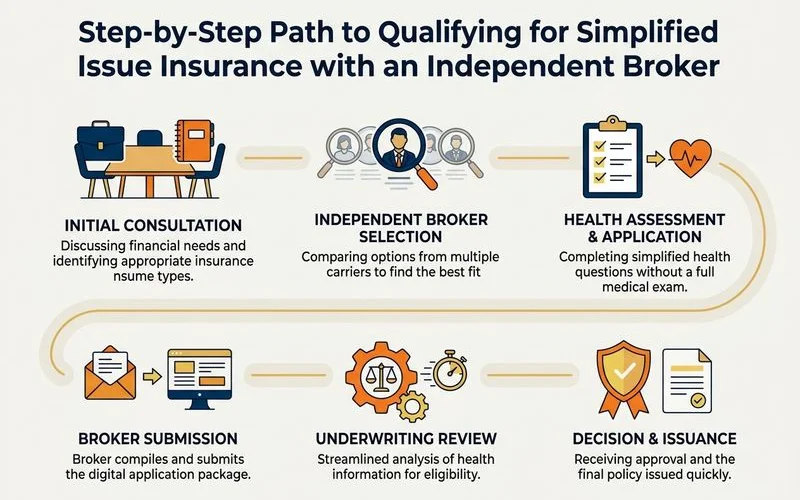
Applying strategically prevents underwriters from assuming you are desperately shopping a declined file or hiding a medical issue. Follow this exact order:
- Talk to an independent broker: Get a single, informal read on which carrier is most likely to approve your profile before submitting any paperwork.
- Apply at your top carrier first: Submit the application and wait patiently for the final decision.
- If declined, move to your backup: A different carrier uses a different actuarial table, which often leads to a completely different outcome.
- Repeat carefully: You can sequence through three to four specific carriers if your broker advises it.
This methodical sequence gives each carrier a clean look at your file.
We use this exact approach to avoid simultaneous application pile-ups and protect your MIB record from unnecessary red flags.
When to Stop Trying
If you have been declined at three to four sequenced A-rated carriers for the exact same condition, qualifying for simplified issue is probably not realistic right now.
Moving to guaranteed issue puts immediate protection in place for your estate.
Our goal is to secure reliable coverage, not chase an impossible standard indefinitely. There are two primary benefits to accepting a guaranteed policy when necessary:
- Locked-in protection: You secure a permanent policy that cannot be canceled due to future health declines.
- Future flexibility: You can always reapply for simplified coverage later once medical lookback periods expire.
All guaranteed issue policies in the US carry a mandatory two-year waiting period before the full death benefit pays out for natural causes. You just need to survive that window to achieve full protection.
The main point is to verify through real, structured shopping that a simplified product is unavailable before falling back to the more expensive option.
Reach out to our team today to review your health profile and secure your family’s financial future.