
We see homeowners and business owners panic when applying for burial insurance with cancer history in the US. From what the data shows, the confusion stems from mixing up standard life insurance after cancer with simplified-issue final expense policies.
This distinction is crucial for protecting your property and family. Our professional service team knows that securing coverage quickly preserves your hard-earned assets.
Let’s look at the facts, what they actually tell us, and explore a few practical ways to respond.
How Carriers View Cancer History
Carriers view your cancer history primarily through a “lookback” window. This window measures the exact time since your last treatment against their specific approval guidelines. Our team often explains that most A-rated simplified-issue carriers analyze your case along three dimensions: type, time since treatment, and current status.
Time since treatment remains the single most important variable. The closer you are to diagnosis, the stricter the underwriting becomes. We mapped out exactly how these timelines affect your options.
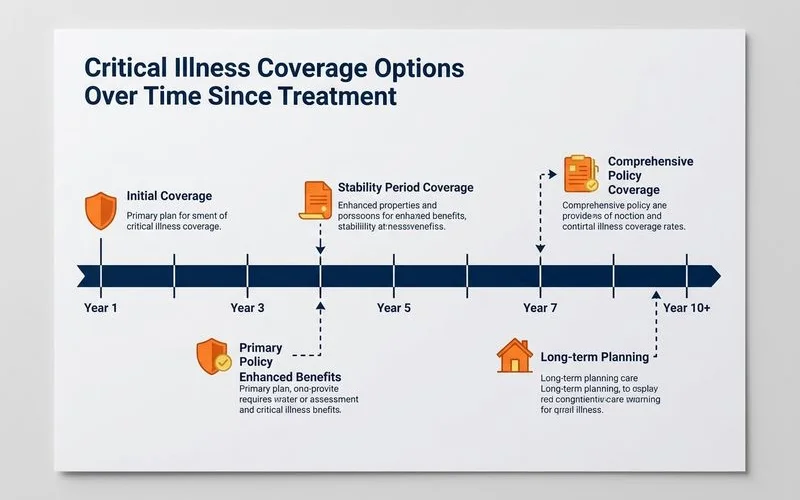
- Active treatment: This phase almost universally requires guaranteed issue. For example, a 65-year-old nonsmoking female in 2026 pays around $90 monthly for a $15,000 guaranteed policy in the US.
- In remission, within lookback (typically 2 to 5 years): Graded simplified issue is available at some carriers, though many decline. Your first-year death benefit is usually partial or stepped.
- Past lookback, in remission: Standard or preferred simplified issue becomes possible at multiple carriers. You can find competitive rates from companies like Transamerica, averaging $33 to $43 a month.
- 10+ years cancer-free: Underwriters treat you like any other applicant. The cancer history is noted but not penalized significantly.
We always suggest checking multiple companies because their rules change annually. Finding the right category saves you money.
Lookback Windows by Cancer Type (Typical)
The typical lookback window ranges from zero years for basal cell skin cancer to up to 10 years for melanoma or lung cancer. These timelines dictate your eligibility for standard rates. Our team tracks these specific timelines across dozens of providers to help you find cancer survivor burial insurance without instant declines.
A prostate cancer survivor might get approved instantly with one company. Another carrier makes that same person wait five years.
| Cancer Type | Typical Simplified-Issue Lookback | 2026 Approval Insight |
|---|---|---|
| Basal cell skin (non-melanoma) | None at many carriers | Usually approved immediately without graded benefits |
| Squamous cell skin | 1 to 2 years | Very high approval rate after brief waiting period |
| Melanoma | 5 to 10 years depending on stage | Stage 1 cases sometimes secure shorter 3-year windows |
| Breast (early stage) | 2 to 5 years | Frequent approvals if no radiation was required recently |
| Prostate (low-grade) | 2 to 5 years | Often approved if PSA levels remain stable |
| Colon (early stage) | 2 to 5 years | Requires clear recent colonoscopy records for best rates |
| Lung | 5 to 10 years, some carriers never | Highly scrutinized, often requires guaranteed issue |
| Pancreatic | 10+ years, many carriers never | Almost always defaults to guaranteed acceptance plans |
| Aggressive/recurrent | Guaranteed issue typically | Requires no-medical-exam policies |
We observe that aggressive treatments like heavy chemotherapy can reset these timelines. These are general guidelines.
Specific carrier underwriting can be more lenient or stricter. Our experts recommend getting a personalized assessment before assuming you are disqualified. This ensures you get the most accurate quote possible.
What to Have Ready for Burial Insurance With Cancer History
You must gather your exact diagnosis date, treatment completion date, and recent oncologist notes before applying. Guessing dates on an application often triggers an automatic denial. Our agency requires clients to collect this specific paperwork to ensure a smooth process.
The Medical Information Bureau (MIB), established in 1902, retains your application history and coded medical flags for up to seven years. Underwriters cross-reference your answers with both the MIB and US national prescription databases. We see applications get flagged instantly if a patient forgets they picked up a specific cancer-related medication.
Here is the exact information you need to gather:
- Cancer type and stage at diagnosis
- Diagnosis date
- Treatment dates and type (surgery, chemo, radiation, immunotherapy)
- Date of treatment completion
- Current status (in remission, on monitoring, recurrence history)
- Recent oncologist follow-up dates
Honest answers protect your family from disputed claims. Undisclosed cancer is among the most common reasons life insurance payouts are delayed or denied. We advise you to disclose everything and let the underwriting process handle the details. Hiding information only hurts your beneficiaries later. If a carrier does turn you away over your cancer history, our guide on what to do when you have been Declined for Life Insurance? What to Do Next walks through the next steps.
Which Carriers to Avoid
Avoid captive carriers that only sell their own products. They cannot offer alternative policies if your specific cancer history disqualifies you. We advise against relying on heavily advertised, single-option companies like Colonial Penn or Lincoln Heritage.
If they decline you based on their rigid cancer guidelines, you have no shopping leverage with them. Captive agents are restricted to one company’s rulebook. Our brokers utilize independent networks because they can move your application across multiple carriers to find the friendliest lookback period.
The Problem With One-Size-Fits-All Plans
Many heavily marketed policies default to guaranteed issue, which means lower coverage caps and higher costs. A 2026 industry review shows that guaranteed policies in the US max out around $25,000 in coverage.
Our team proves that you can often secure double that amount for the same price if you work with an independent agency. These independent agencies will match your exact cancer type to the carrier with the most favorable guidelines.
This strategy prevents you from overpaying for unnecessary restrictions. We always stress the importance of shopping around. Your financial situation deserves a personalized approach.
The Soft Bridge
The “soft bridge” refers to finding simplified-issue coverage that provides full protection without the steep costs of guaranteed-issue plans. Cancer history does not automatically mean you are stuck paying exorbitant premiums. Our staff considers this the sweet spot for cancer survivors who have safely passed their lookback window.
Simplified issue is often available at competitive rates if you know where to look. The right carrier among the six or eight A-rated options can save thousands over the life of the policy. We recommend getting a real comparison before assuming the worst. When evaluating these soft bridge options, look for a few key features:
- Fixed premiums that never increase over time
- Fast and simple claims processes
- No medical exam requirements
Finding the best burial insurance with cancer history is entirely achievable. Taking action today ensures your home and business assets remain protected from end-of-life expenses. We encourage you to gather your medical dates and reach out for a personalized quote.
Start comparing your options right now. This is the smartest way to secure the peace of mind your family deserves.