
The Four Tiers, Top to Bottom
Final expense insurance underwriting essentially runs on a four-tier ladder. Each tier trades off how easy it is to qualify against how good the coverage is. The top tiers give you full coverage from day one at the lowest rate. The bottom tiers approve almost anyone — but cost more and limit early-year benefits.
1. Preferred / Standard (Simplified Issue, Best Class). Short health questionnaire only, no exam. Full death benefit from day one. Locked-in level premiums. Best rates available. Typical fit: relatively healthy applicants, controlled common conditions, no recent major events.
2. Graded Benefit (Simplified Issue, Lower Class). Same kind of questionnaire, but answers reveal a condition that disqualifies preferred. Carrier offers a policy with a partial benefit in years 1–2 (often 30% / 70% / 100% of face value as years pass). Premium is higher than preferred but lower than guaranteed.
3. Modified Benefit. Variant of graded. Usually pays return of premium plus interest if death is from natural causes during the first 2–3 years. Some carriers call their tier “modified” instead of “graded” — terminology is not standardized across the industry.
4. Guaranteed Issue. No health questions, no medical exam. Approves everyone aged 50–85. Returns premiums plus interest if death is from natural causes during a 2- to 3-year waiting period. Full benefit applies after. Most expensive per dollar of coverage. See the Guaranteed Issue Life Insurance hub for the full mechanics.
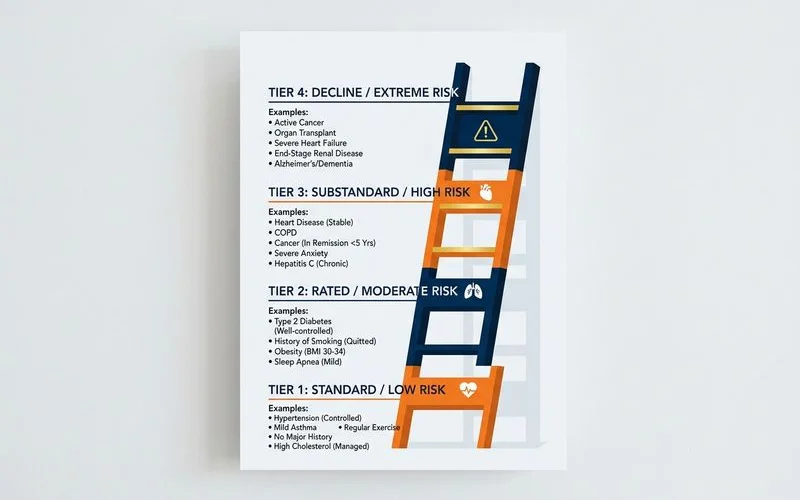
Where Common Conditions Tend to Land
These are rough guidelines — every carrier’s table is different.
| Condition | Typical Tier(s) |
|---|---|
| Healthy, well-controlled blood pressure | Preferred |
| Controlled Type 2 diabetes, no insulin | Preferred or Standard |
| Insulin-dependent diabetes | Standard or Graded |
| COPD, mild, no oxygen | Standard or Graded |
| COPD, oxygen-dependent | Graded or Guaranteed |
| Cancer, 5+ years remission | Standard or Graded |
| Cancer, current treatment | Guaranteed |
| Heart attack 5+ years ago, stable | Standard or Graded |
| Recent stroke (within 2 years) | Graded or Guaranteed |
| Dementia diagnosis | Guaranteed |
Where exactly you land depends on the specific carrier. This is the single biggest reason independent agents matter: the same applicant can be preferred at Mutual of Omaha, graded at one peer carrier, and a flat decline at another — for the exact same health condition.
Why the Same Condition Prices Differently
Carriers underwrite based on their internal experience and reinsurer guidance. A carrier that’s had good claims experience with insulin-dependent diabetics will be more aggressive on that condition than one that hasn’t. This is normal — and it’s where shopping pays.
A captive agent shows you one carrier’s tier for your profile. An independent agent who handles dozens of carriers each month knows which one is most likely to put you in the highest tier today. That’s the entire value proposition.
Practical Implications
- Aim for preferred / standard. Try simplified issue across multiple A-rated carriers before defaulting into graded or guaranteed.
- A decline isn’t terminal. A “no” at one carrier doesn’t mean “no” everywhere. Another carrier may have a friendlier tier table for your condition.
- Guaranteed issue is a real option — not a fallback to fear. If your health truly rules out simplified issue, guaranteed issue exists for a reason and is genuinely valuable. Just make sure you’ve ruled out the cheaper options first.
The structure of the tier ladder isn’t intuitive when you first encounter it. But once you understand that tiers exist and that the same condition lands differently at different carriers, the case for shopping independently becomes obvious. That’s the whole game.